

Buying a mattress today is significantly more complex than it was a decade ago. In the past, most mattresses fell into one or two basic categories, and choices were largely limited to firmness preference and price. Modern mattresses, however, are engineered products. They differ by material composition, internal construction, size standards, and the specific sleep needs they are designed to support.
As a result, many consumers feel overwhelmed when researching mattresses. Terms such as latex, memory foam, hybrid, zoning, or pocket springs are frequently mentioned, but not always clearly explained. This guide is designed to provide a comprehensive, foundational understanding of mattress types, explaining how they are categorized, how they differ, and why those differences matter.
Rather than focusing on a single product or recommendation, this article explains mattress types holistically. It serves as a reference point that helps readers understand how materials, construction methods, sizes, and sleep requirements intersect—forming the basis for more specific mattress guides.
Mattress Types Based on Material
The material used in a mattress plays a central role in how it feels, how it supports the body, and how it performs over time. Material choice affects pressure relief, responsiveness, temperature regulation, and durability.

Latex Mattresses
Latex mattresses are made using natural latex, synthetic latex, or a blend of both. Natural latex is derived from rubber tree sap, while synthetic latex is manufactured to replicate similar properties at a lower cost. Regardless of source, latex is known for its elasticity, resilience, and long lifespan.
Unlike memory foam, latex responds immediately to movement. It contours to the body without allowing excessive sink, creating a floating or buoyant sensation. This responsiveness makes it easier to change sleeping positions during the night. Latex is also naturally breathable due to its open-cell structure and pinhole design formed during production, which allows air to circulate through the mattress.
Because of its durability and consistent support, latex is often associated with premium mattresses and is commonly chosen by sleepers who want long-term performance, balanced comfort, and better temperature regulation.
Memory Foam Mattresses
Memory foam mattresses are designed to respond to heat and pressure. As body weight is applied, the foam softens and molds closely to the body’s shape, redistributing pressure across contact points such as the shoulders, hips, and lower back.
This close contouring provides strong pressure relief and motion isolation, which is why memory foam is popular among side sleepers and couples. Movement on one side of the bed is less likely to disturb the other sleeper.
However, traditional memory foam tends to retain heat. To address this, modern memory foam mattresses often incorporate cooling technologies such as gel infusions, open-cell foam structures, or breathable cover materials. Memory foam mattresses are typically recommended for sleepers who prioritize cushioning and pressure relief over responsiveness.
Hybrid Mattresses
Hybrid mattresses combine two or more support systems, usually a foam or latex comfort layer placed over a coil support core. The purpose of a hybrid design is to capture the benefits of multiple mattress types in a single structure.
By combining coils with foam or latex, hybrid mattresses often provide better airflow, stronger edge support, and a more balanced feel than all-foam designs. The coils offer structural stability and responsiveness, while the comfort layers deliver pressure relief.
Because hybrid mattresses vary widely in construction, their performance depends heavily on the quality and thickness of each layer. They are often chosen by sleepers who want cushioning without sacrificing bounce or support.
Innerspring Mattresses
Innerspring mattresses use metal coils as their primary support system, typically topped with thin layers of foam or fiber padding. This is one of the oldest mattress constructions still in use today.
Innerspring mattresses tend to feel firmer and more responsive, with noticeable bounce. They also allow for good airflow due to the open space between coils. However, they generally offer less pressure relief than foam- or latex-based mattresses and may transfer motion more easily.
While traditional innerspring mattresses are less common in the premium segment, they remain relevant for sleepers who prefer a firm, supportive feel or are seeking a more budget-oriented option.
Pocket Spring Mattresses
Pocket spring mattresses use individually wrapped coils rather than interconnected spring systems. Each coil moves independently, allowing the mattress to respond more precisely to body weight and movement.
This construction reduces motion transfer and improves contouring compared to traditional innerspring designs. Pocket spring systems are often used in higher-end mattresses and are frequently combined with foam or latex layers to enhance comfort.
Pocket springs are commonly found in hybrid and premium spring mattresses, especially those designed for couples or sleepers sensitive to movement.
Mattress Types Based on Construction and Engineering
Beyond material choice, mattress construction refers to how layers are arranged and how support is distributed across the sleeping surface.
All-Foam Construction
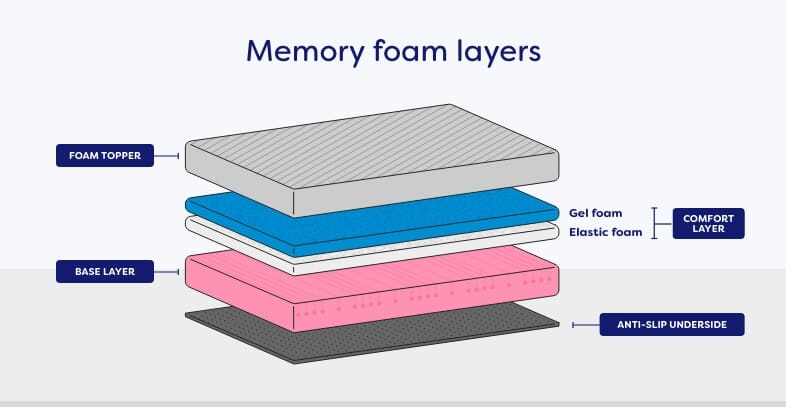
All-foam mattresses rely entirely on foam layers for both comfort and support. These mattresses typically use multiple foam densities, with softer layers on top for pressure relief and firmer layers below for structural support.
This construction minimizes noise and motion transfer, making all-foam mattresses suitable for shared sleeping environments. However, the quality of foam used is critical, as lower-density foams may degrade more quickly over time.
Zoned Support Construction
Zoned mattresses are engineered with varying firmness levels across different sections of the bed. Commonly, firmer zones are placed under the hips and lower back, while softer zones support the shoulders and legs.
The goal of zoning is to maintain proper spinal alignment regardless of sleeping position. Zoned construction is often used in mattresses marketed for ergonomic or orthopedic support, though its effectiveness depends on accurate zone placement and overall mattress design.
Dual Comfort and Adjustable Construction
Some mattresses offer dual comfort configurations, either through flippable designs or adjustable internal layers. These mattresses provide different firmness levels on each side or allow customization based on personal preference.
Dual comfort construction is often chosen by couples with different comfort needs or by sleepers whose preferences change over time. While flexible, these designs require careful engineering to maintain consistent support.
Mattress Types Based on Size
Mattress size influences not only room layout but also sleep quality, comfort, and movement freedom.
Understanding Mattress Sizes
Common mattress sizes include single, twin, queen, and king, though exact dimensions vary by region. Single and twin mattresses are typically used for children, guest rooms, or smaller living spaces. Queen mattresses are the most popular choice for couples, offering a balance between space efficiency and comfort.
King mattresses provide the most sleeping space and are often selected for master bedrooms or households where co-sleeping occurs. Beyond dimensions, mattress size affects partner disturbance, ease of movement, and compatibility with bedroom furniture.
Choosing the correct size is an important foundational decision, as it influences both comfort and long-term satisfaction.
Mattress Types Based on Sleeping Needs and Use Cases
Many consumers search for mattresses based on specific problems or lifestyle needs rather than materials alone. These use-case categories often overlap with material and construction choices.
Mattresses designed for back pain typically emphasize spinal alignment and consistent support. Mattresses for hot sleepers focus on airflow, breathable materials, and temperature regulation. Couples often prioritize motion isolation and edge support, while side sleepers usually require enhanced pressure relief at the shoulders and hips.
Understanding mattress types by use case helps narrow choices, but it is most effective when combined with knowledge of materials and construction.
Consider Lazy Lowie For Your Comfort Sleep
Mattresses are complex products designed to support the body for thousands of hours over many years. Differences in material, construction, size, and intended use all contribute to how a mattress performs and who it is best suited for.
By understanding the major mattress types and how they are categorized, consumers can move beyond surface-level features and make decisions based on comfort, support, and long-term suitability. This guide provides a foundational framework—one that supports deeper exploration into specific mattress categories and more informed choices overall.